Halo is the deeper treatment for sun damage, age spots, fine lines, and texture, while MOXI is the gentler non-ablative option for early aging, dullness, and maintenance. Halo combines ablative and non-ablative wavelengths and often delivers strong results in one session with about five to seven days of recovery, while MOXI usually takes one to three treatments with a day or less of downtime.
Short version: Choose Halo for correction and MOXI for prevention, and many patients use both across the year.
Halo Laser vs MOXI Laser is the question that comes up almost every day at our Edina clinic. Both are made by Sciton, both are fractional lasers, and both are designed to refresh the skin without the downtime of older resurfacing options. The short version: Halo is the deeper, more comprehensive treatment built for patients who want significant change in tone, texture, and pigmentation in just one or two sessions. MOXI is the gentler, brighter-glow treatment built for patients in their twenties through forties who want maintenance, prevention, or a polish ahead of an event. At Skin Rejuvenation Clinic, we offer both, and the right choice depends on your skin, your goals, and how much downtime you can accommodate.
A Quick Overview of How Halo and MOXI Differ
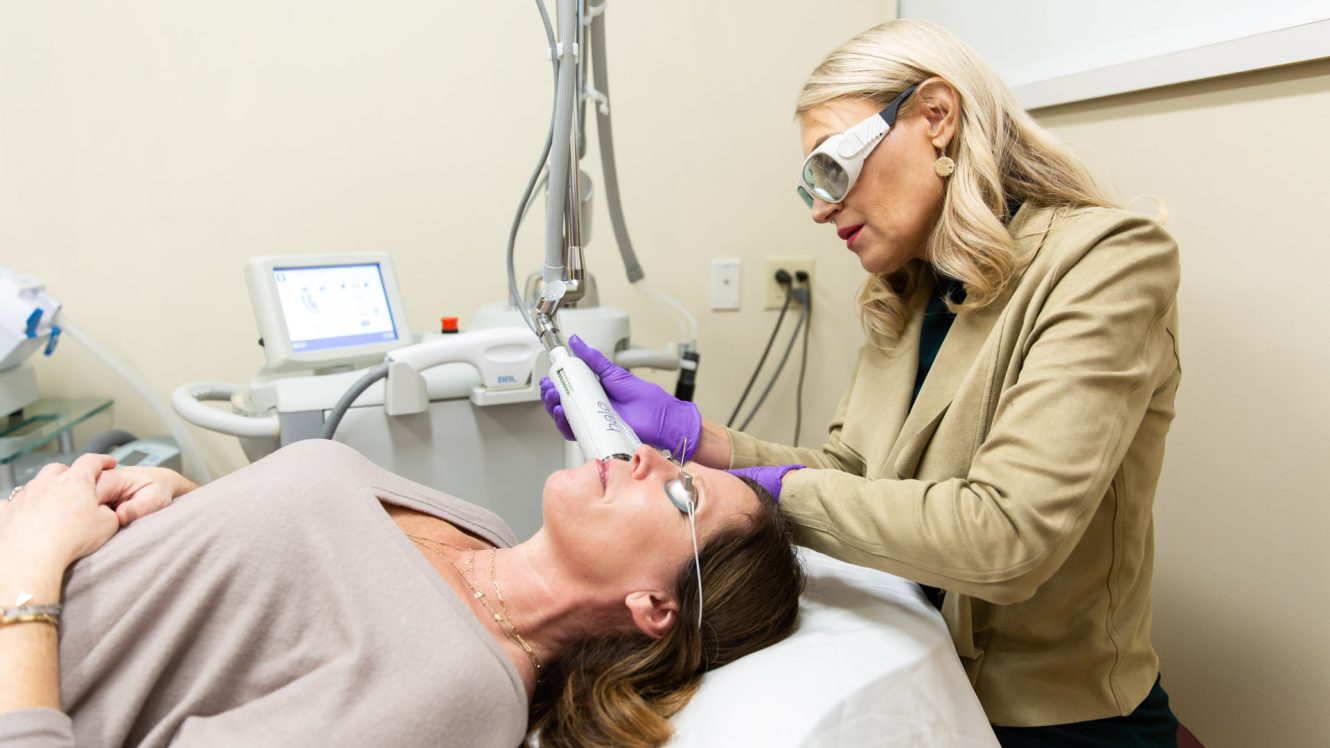
Our Halo Laser treatment in Edina is a hybrid fractional laser, meaning it combines two wavelengths in a single session: one ablative wavelength that resurfaces the top layer of skin, and one non-ablative wavelength that penetrates deeper to stimulate collagen and treat pigmentation. That dual action is what makes it so effective for patients dealing with sun damage, age spots, fine lines, and uneven texture.
MOXI Laser is a non-ablative fractional laser. It works entirely below the surface, using a 1927 nm wavelength to address early signs of aging, mild pigmentation, and overall dullness. There is no ablative component, which means MOXI is gentler, faster, and friendlier for skin tone variation and busy schedules.
The simplest way to think about Halo vs MOXI: Halo is a deeper rejuvenation treatment; MOXI is a refreshing tune-up. They are not interchangeable, but they do complement each other in a long-term skincare plan.
How Does Halo Laser Work?
Our Halo Laser treatment in Edina uses the Sciton hybrid fractional platform to deliver both wavelengths in one pass. The ablative side addresses surface concerns like texture, pore size, and rough skin tone. The non-ablative side reaches deeper to support collagen remodeling and break up pigmentation that has settled below the surface.
Patients typically see visible improvement in skin clarity within the first week or two, with continued collagen-driven results developing over three to six months. Most patients see significant results from a single Halo session, though some choose a second treatment for more advanced concerns. It is a strong fit for patients with sun damage, hyperpigmentation, fine lines, enlarged pores, or mild scarring who want comprehensive improvement without surgery.
Recovery is real but manageable. Expect redness and a sandpaper-like texture for the first three to five days, with peeling around days three through five, followed by a noticeable glow as the new skin emerges.
How Does MOXI Laser Work?
MOXI uses a single non-ablative wavelength designed for everyday patients who want to prevent and address early aging without disrupting their week. Because it does not break the skin’s outer layer, MOXI is well-suited to patients with melasma, mild discoloration, dullness, or sun damage who want a brighter, more even complexion without the downtime of a deeper treatment.
It is often the first laser treatment many patients try, and it is one of the most popular treatments in our clinic for patients in their twenties, thirties, and early forties. MOXI is also a strong choice for darker skin tones, since the non-ablative approach reduces the risk of post-inflammatory pigmentation when performed by an experienced provider.
Many patients choose a series of three MOXI treatments spaced about a month apart, then return for maintenance once or twice a year. Recovery is faster than Halo, with mild redness and a coffee-ground texture for one to three days as the skin clears.
Halo Laser vs MOXI Laser: Side-by-Side Comparison
| Feature | Halo Laser | MOXI Laser |
|---|---|---|
| Laser Type | Hybrid fractional (ablative + non-ablative) | Non-ablative fractional |
| Wavelengths | Dual: 2940 nm (ablative) + 1470 nm (non-ablative) | Single: 1927 nm (non-ablative) |
| Best For | Sun damage, age spots, fine lines, texture, pigmentation, enlarged pores | Dullness, early aging, mild pigmentation, melasma, maintenance |
| Treatment Depth | Surface and mid-dermis | Upper dermis |
| Sessions Recommended | Typically 1 to 2 | Series of 1 to 3, then periodic maintenance |
| Downtime | 5 to 7 days of redness and peeling | 0 to 1 day of mild redness and bronzing |
| Ideal Age Range | Late 30s through 60s | Late 20s through 40s |
| Comfort | Topical numbing required | Topical numbing recommended |
| Results Timeline | Initial glow in 1 to 2 weeks; full results develop over 3 to 6 months | Initial glow within days; full results in about 3 to 4 weeks per session |
Which Treatment Is Right for You?
The answer comes down to four things: how much downtime you can take, how advanced your concerns are, your skin type, and your long-term plan. Patients tend to fall into one of a few candidate profiles:
- You want significant improvement in pigmentation, sun damage, or texture in one or two sessions and can take a week of visible recovery: Halo is usually the right call
- You want a glow-up before a wedding, reunion, or photo shoot and have only a few days to recover: MOXI is the cleaner fit
- You are in your twenties or thirties, focused on prevention and maintenance: MOXI is the smarter long-term entry point
- You are in your forties or fifties with stacked concerns including spots, lines, and dullness: Halo will likely give you more value per session
- You want to combine both approaches across the year, using Halo as the foundation and MOXI as the maintenance: many of our patients build their long-term skin plan exactly this way
None of these profiles are rigid. A consultation gives our team the chance to look at your skin under proper lighting, ask about your day-to-day life, and recommend the option that fits both your goals and your timeline.
Timing and spacing are part of the plan too. Halo sessions should be at least four to six weeks apart, and many patients book one Halo treatment a year as a reset. MOXI treatments are spaced at least a month apart, with periodic maintenance to hold results. Because both treatments leave skin more sensitive to light, many Minnesota patients schedule resurfacing in fall and winter, when it is easier to limit sun exposure. Daily broad-spectrum sunscreen before and after treatment protects your results and lowers the risk of new pigment.
What Is Recovery Like After Halo and MOXI?
Halo recovery starts with warmth and redness within the first few hours, followed by a tight, sunburned feeling that resolves over two to three days. Around day three, the skin begins to peel in a fine, dust-like layer. By day five to seven, the new skin underneath has a smoother texture and a visible glow that continues to deepen as collagen rebuilds.
MOXI recovery is faster. Expect mild redness for the first 24 hours, followed by a bronzing effect as the treated skin sloughs naturally. Most patients are back in full makeup and normal activity within two to three days. The brightening effect typically peaks at the three- to four-week mark per session, with results compounding across a series.
Both treatments deliver durable results when paired with consistent sunscreen, a medical-grade skincare routine, and the kind of long-term plan our providers build with every patient.
Why Choose Skin Rejuvenation Clinic in Edina for Halo and MOXI?
Skin Rejuvenation Clinic was founded in 2004 by Dr. Elizabeth and Dr. Mark Hagberg, and our team has been performing Halo and MOXI treatments since each was first introduced to the market. We are recognized as one of the top-performing clinics in Minnesota for both treatments based on provider performance data, and we have been ranked among the top Halo practices in the world.
That depth of experience matters in laser resurfacing. The settings, timing, and combinations are not one-size-fits-all, and skin types respond differently. The benefit of working with a team that has performed thousands of these treatments is that the right energy levels, the right intervals, and the right pairings get matched to your specific skin from the first session, not the third.
It is also why patients across Edina, Bloomington, and the wider Twin Cities have trusted us with their resurfacing work for two decades.
Your Next Step
If you are weighing Halo vs MOXI for your skin, the most useful next step is a consultation. Our team can look at your skin in person, ask about your goals and schedule, and help you decide which treatment lines up with the result you want.
Reach out to Skin Rejuvenation Clinic to schedule a consultation in Edina. We will walk through your options, explain what each treatment can realistically do for you, and build a plan that fits your skin and your life.
References
- Waibel JS, Pozner J, Robb C, Tanzi E. Hybrid fractional laser: a multi-center trial on the safety and efficacy for photorejuvenation. Journal of Drugs in Dermatology, 2018.
- Brauer JA, Alabdulrazzaq H, et al. Evaluation of a low energy, low density, non-ablative fractional 1927 nm wavelength laser for facial skin resurfacing. Journal of Drugs in Dermatology, 2015.